
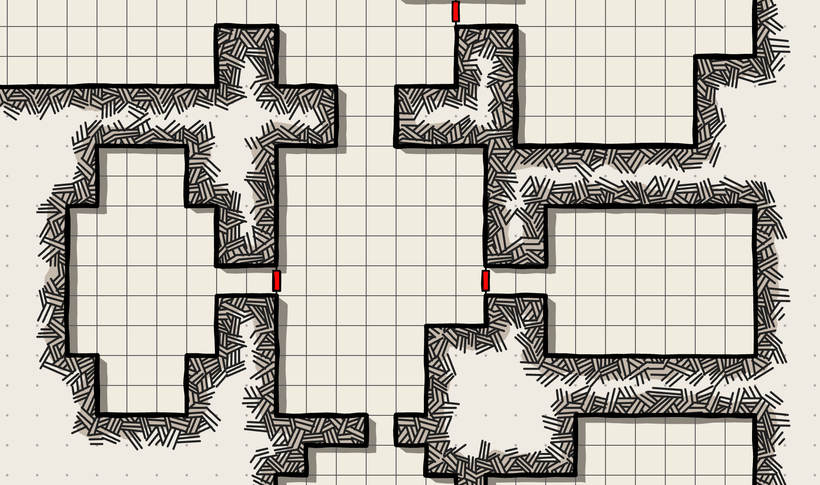
 Maps created with Dungeon Scrawl (https://dungeonscrawl.com) — used under CC BY 4.0 license.
Welcome to November, everyone!
I’m writing some new adventures, and I have been spending time thinking about how I want the encounter entries to look. Note: I’ll use the term “room” repeatedly, but it can be any kind of location, indoors or outdoors. They should accomplish several things:
Give the GM a quick summary of what’s in the room as a reminder. Include monsters, traps, and other features. Also indicate which of these things, if any, are hidden so the GM does not accidentally give away traps, etc.
I believe published adventures should provide “read-aloud descriptions” the GM can use if they choose, rather than forcing them to improvise the room description. However, there are a few things to keep in mind.
Include non-hidden monsters in the description. Nothing breaks a player’s immersion more than a two-paragraph room description followed by the GM tacking on, “Oh yeah, there is also a troll in the middle of the room” because it wasn’t in the description. That is the first thing they would notice
If players can enter the room in more than one way, don’t assume they used a specific entrance.
Avoid cardinal directions (north, south, etc.) in the description in favor of left or right. That is just how people think, especially if they are inside.
The above point will likely necessitate having multiple room descriptions, and I think that is okay. A good way to handle this is very short (one or two-sentence) “at a glance” descriptions. You will probably need one for each entrance. Then one longer “upon inspection” description for when the players have dealt with any immediate threat and have a chance to look around.
Encounter scaling for more or fewer players. Most published adventures assume 4 players as the baseline, which determines encounter difficulty. It really depends on the publisher whether an adventure provides any guidance on how to raise or lower the challenge based on the number of players. I think it should.
Include a quick guide on adding, removing, or even swapping out monsters entirely.
Include instructions on changing traps or other hazards. It may be less believable that the spikes at the bottom of a pit suddenly vanish than that the room has only 3 goblins instead of 4, but only the GM will ever know.
So that is what I have been thinking about, and here is the format that I have come up with.
{PF1 Version}
A.## EncounterName (CR ##)
XP ##
{PF2 Version}
A.## EncounterName Threat #
{5E Version}
A.## EncounterName XP ##
{scaling encounter A.## sidebar}
Scaling Encounter A.## EncounterName
3 players: remove/replace {hidden/invisible} ## creatures/hazards/haunts. (CR ##, XP ##) or skip this encounter.
4 players: run as written.
5 players: add/replace {hidden/invisible} ## creatures/hazards/haunts. (CR ##, XP ##)
6 players: add/replace {hidden/invisible} ## creatures/hazards/haunts. (CR ##, XP ##)
{end sidebar}
Quick Reference
## {creatures} plus ## hidden/invisible {creatures} (Perception DC XX, hiding in xxx)
{Name} haunt/hazard/trap on location (Perception DC XX to notice)
{location} has {lighting condition} or {lighting condition} at night
At first glance: Read Aloud Description #1 (includes obvious creatures and a quick description of the room/area) {omit if no obvious creatures}
At first glance: Read Aloud Description #2 (includes obvious creatures and a quick description of the room/area) {omit if no obvious creatures}
Upon Inspection: Read Aloud Description #3 (includes full room description including any visible signs of a haunt, hazard, trap, or treasure. This should not contain any reference to creatures.)
Additional GM information
{omit if no creatures}
Creatures: Additional GM Information including difficult terrain and additional lighting info.
{creature stat blocks}
{omit if no haunt}
Haunt: GM information including location of haunt/trigger
{haunt stat block}
{omit if no hazard}
Hazard: GM Information including location
{hazard stat block}
{omit if no treasure}
Treasure: GM Information including all items found in room.
XP Award: List the XP award for the party
Development: GM Information detailing the results of any actions characters can take that impact the plot or environment.
That template format may be a bit hard to read. I use it as a starting point to fill in an encounter’s details. That keeps everything in the right order since most encounters will not have every detail.
Here is an example. Web-Filled Barn, an encounter for Pathfinder First Edition.
A.4 Web-Filled Barn (CR 6)
XP 2,400
{scaling encounter sidebar}
Scaling Encounter A.4 Web-Filled Barn
3 players: replace the Acid Arrow Trap with the Burning Hands Trap; remove the hidden spider (CR 5, XP 1,600)
4 players: run as written.
5 players: run as written.
6 players: add 1 additional spider plus 1 additional hidden spider. (CR 7, XP 3,200)
{end sidebar}
Quick Reference
3 spiders plus 1 hidden spider (Perception DC 21, hiding in the webs)
1 hidden door (Perception DC 15, obscured by the webs)
Acid Arrow Trap on hidden door (Perception DC 27 to notice)
The barn has dim light in daytime or is dark at night
At first glance: Three large spiders infest this rustic barn, which is filled with their webs. The area under the hayloft, towards the rear of the barn, is almost completely obscured by webs. Only a large hole in the roof lights the area.
Upon Inspection: This abandoned barn is constructed of rustic timbers. Large double doors in the south wall lead outside. Spider webs fill the barn, especially thick at the north end under the hayloft. A rickety wooden ladder leads up to the loft. Empty animal stalls line both the east and west walls. Sunlight filters in through a hole in the roof, casting dim light.
The area under the hayloft is difficult terrain due to the thick webs. A door in the north wall is obscured by thick webs (Perception DC 15 to notice). The door is trapped – see below.
Creatures: The spiders attack any creatures that enter the barn. The hidden spider will try to sneak to an advantageous position on round 1 to attack the closest character on round 2.
Giant Spider (4) CR 1
XP 400 each
hp 16 each (Pathfinder Roleplaying Game Bestiary)
Trap: An Acid Arrow Trap is on the north door. When scaling the encounter for 3 players, use the Burning Hands Trap.
Acid Arrow Trap CR3
Type magic; Perception DC 27; Disable Device DC 27
Effects
Trigger proximity (alarm); Reset none
Effect spell effect (acid arrow, Atk +2 ranged touch, 2d4 acid damage for 4 rounds)
Burning Hands Trap CR1
Type magic; Perception DC 26; Disable Device DC 26
Effects
Trigger proximity (alarm); Reset none
Effect spell effect (burning hands, 2d4 fire damage, DC 11 Reflex save for half damage); multiple targets (all targets in a 15-ft. cone)
Treasure: A corpse, one of the spiders’ previous victims, lies in the second stall on the east. The body holds a masterwork short sword, a chain shirt, a sunrod, and 42 gold pieces.
Development: Killing the spiders will end the nocturnal disappearance of local sheep. If the characters have gained the appropriate quest from the local farmers, they may claim the rewards when they return to town.
Please let me know what you think. It may not be groundbreaking, but I hope it will be a useful format. Also, let me know if I should start posting mini-adventures, one room per week.